Creating Volume Discounts offers
Last updated on September 17, 2026
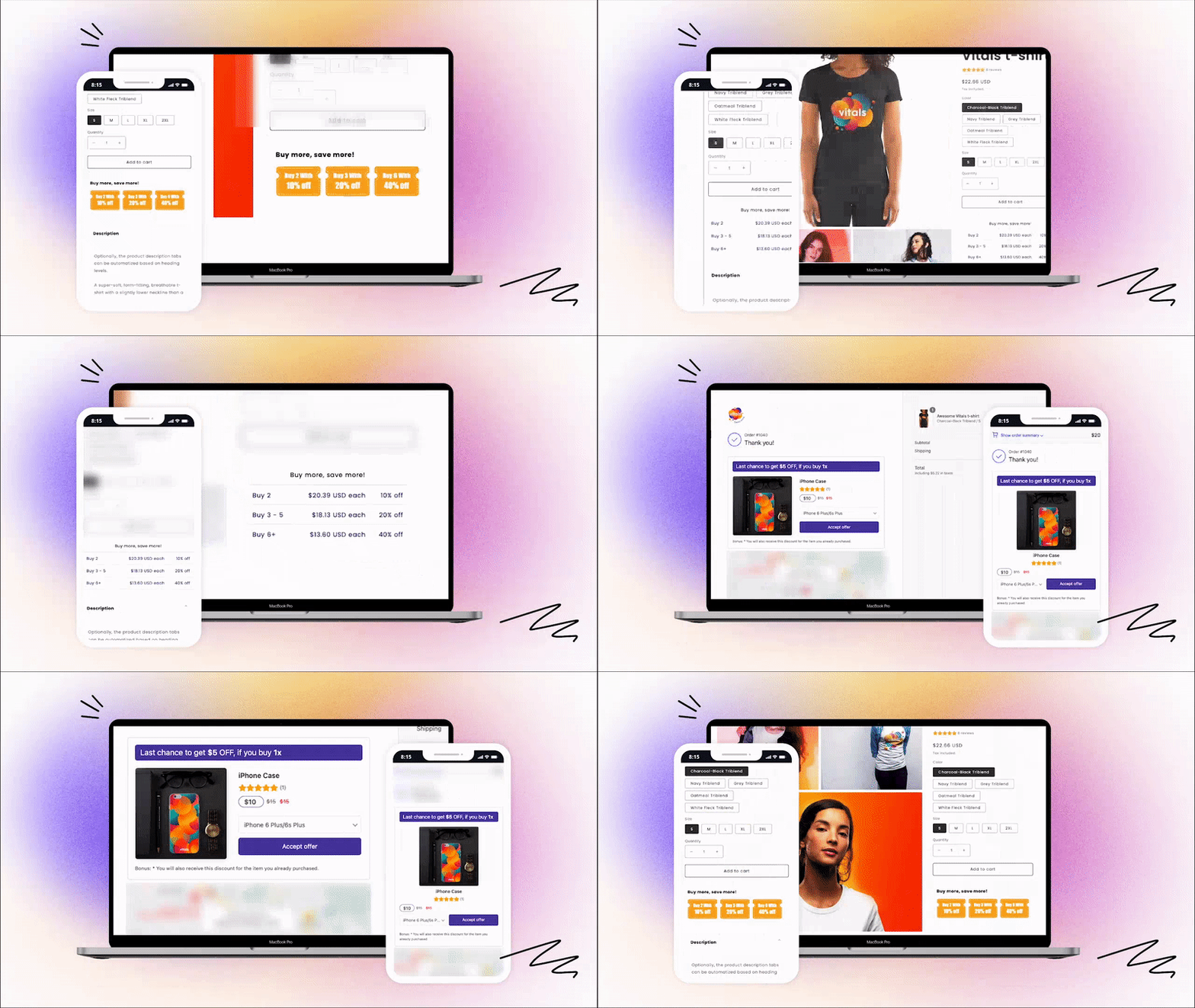
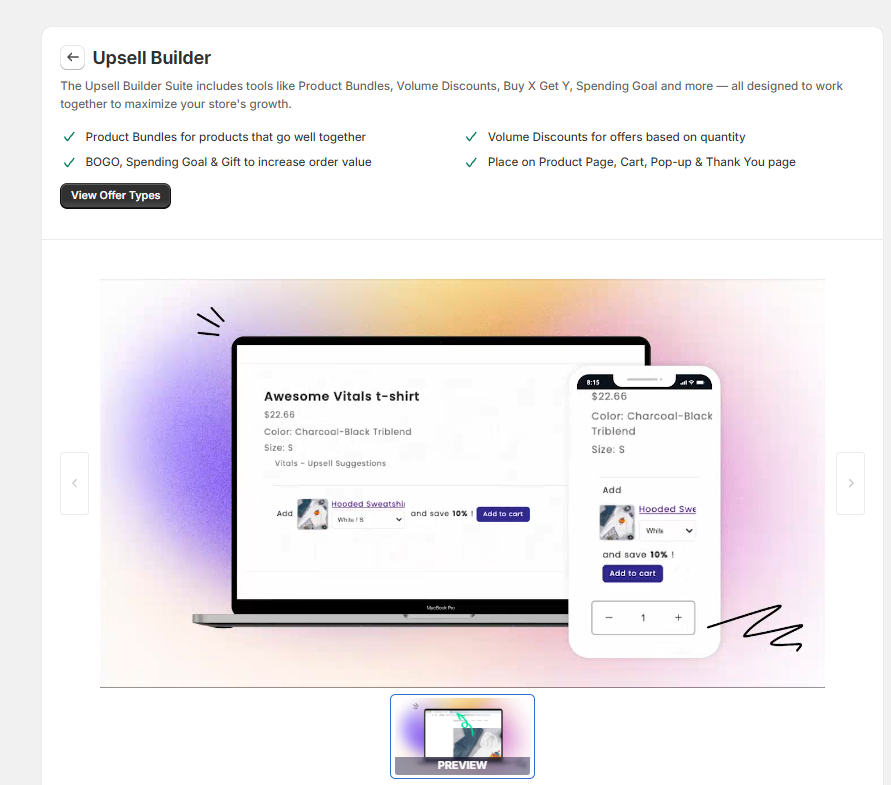
A Volume Discount offer rewards shoppers for buying more - either more of the same product or more items from a set you choose - by unlocking a better price at each quantity tier. Think buy 4, get 20% off or buy 6 from a collection, save 15%. It's one of the most reliable ways to lift your average order value (AOV) and conversions.
This guide walks you through creating a Volume Discount offer in Upsell Builder from start to publish: choosing a layout, setting who the discount applies to, building your quantity tiers, styling the offer, and turning on extra placements across the buying journey.
💡 Got a question about our Upsell Offers? We have a list of frequently asked questions about our Upsell Offers that you can check here: Upsell Builder FAQs
Is this for me?
Use the table below to see whether a Volume Discount fits your goal.
| Your goal | Is Volume Discount a fit? |
|---|---|
| Sell more units of the same product per order | Yes — set tiers like buy 4, save 20% |
| Get shoppers to buy more from a collection or set | Yes — apply the discount across selected products |
| Bundle a few different specific products together | Consider a Product Bundle offer instead |
| Reward shoppers for hitting a spend amount | Consider a Spend Goal or Gift Offer instead |
Before you start - Upsell Builder is part of the Vitals app, so make sure Vitals is installed, and the App embed is activated on your store. If you plan to use the Thank You page placement, you may also need to add its widget in the Shopify theme editor first (covered in Step 17).
Step 1: Understand what the Volume Discount offer does
Before you build, it helps to know the goal. A Volume Discount encourages customers to add more items by offering a discount at set quantity levels — for example, no discount on a single unit, but 20% off once they reach four. You control which products qualify and how steep each tier's discount is.
Step 2: Open Upsell Builder and start a new offer
In Shopify, open the Apps section in the left sidebar and click Upsell Builder.
- First time here? You'll see a splash screen introducing the app.
- Already created offers? You'll land on your saved offer list instead.
Click Create offer to begin. It opens the Choose your offer type page, where you pick what kind of offer to build.
Step 3: Choose the Volume Discount layout
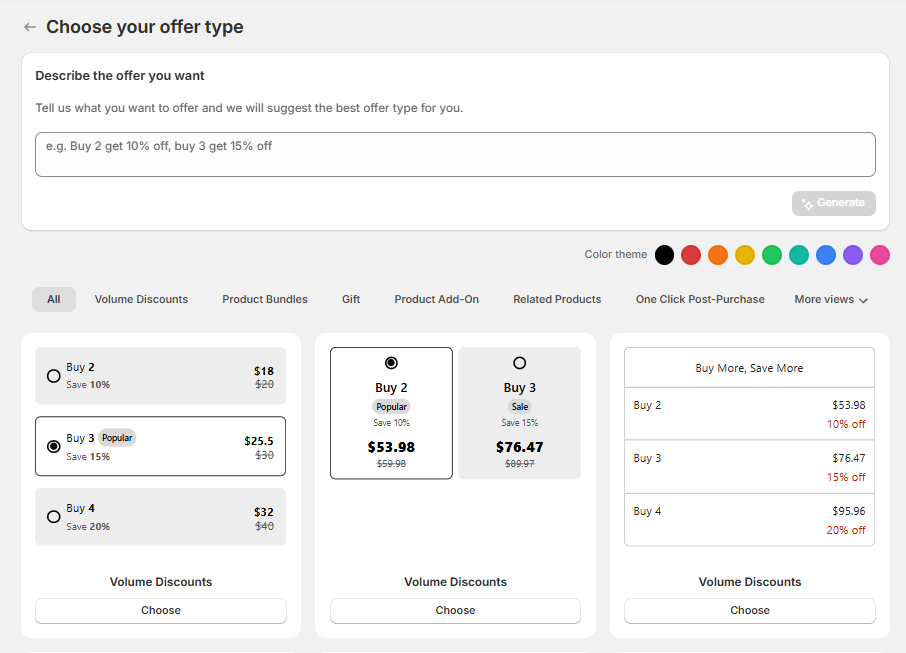
Select the Volume Discount offer type. From here you can either let the AI generate the offer setup for you, or customize it manually for more control.
Then pick one of the available layout styles:
- Vertical bars
- Horizontal bars
- Table
This choice isn't final — you can switch the layout later inside the builder.
Inside the builder the layouts go by slightly different names: Vertical bars is Light, Horizontal bars is Cards, and Table is Table. The builder also offers a fourth layout, Details.
Step 4: Get familiar with the builder
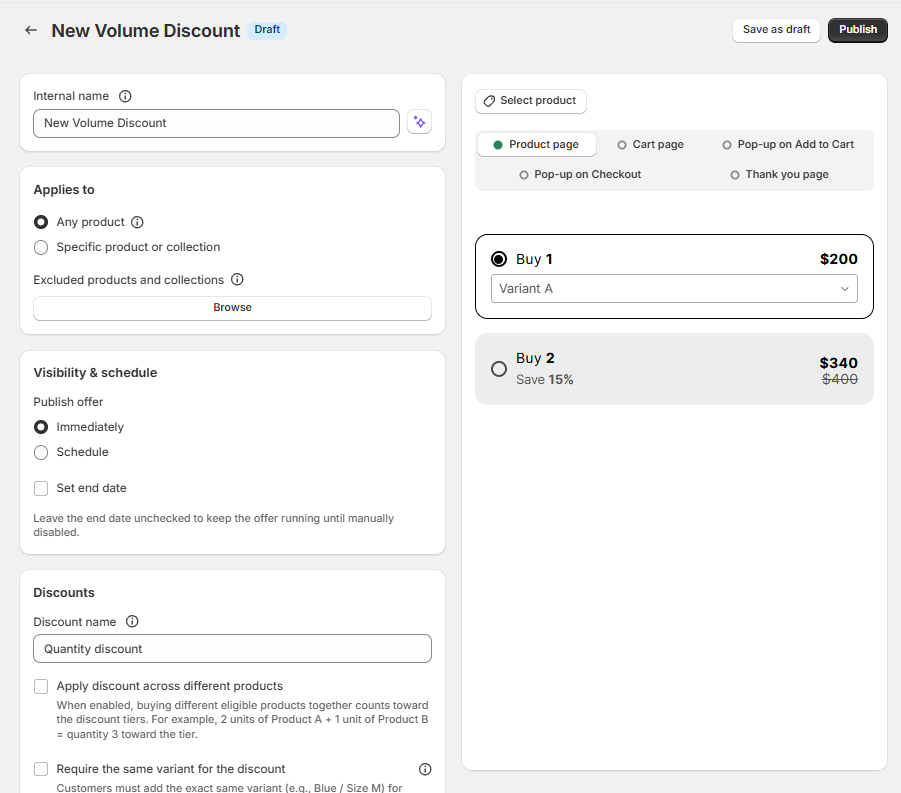
After you pick a layout, the builder opens as a single page — there are no steps to click through:
- The left side holds the editable settings.
- The right side shows a live preview of how the offer will appear to shoppers.
Most options are optional - enable only the ones you need. The preview updates as you go, so you can see how the discount will look across the customer journey.
Step 5: Set an internal name for the offer
Give the offer an internal name so you can find it later inside Upsell Builder. This name is for you, not your customers.
Type something descriptive like Men's Fashion Volume Discount , or use the AI button to suggest a name. The AI suggestion works best after you've configured the rest of the offer.
Step 6: Choose which products or collections the discount applies to
By default, the discount applies to all products in your store. To narrow it down, choose either:
- Specific products
- Specific collections
Search and select exactly what you want included. For products with variants, you can go a level deeper and choose specific variants rather than the whole product.
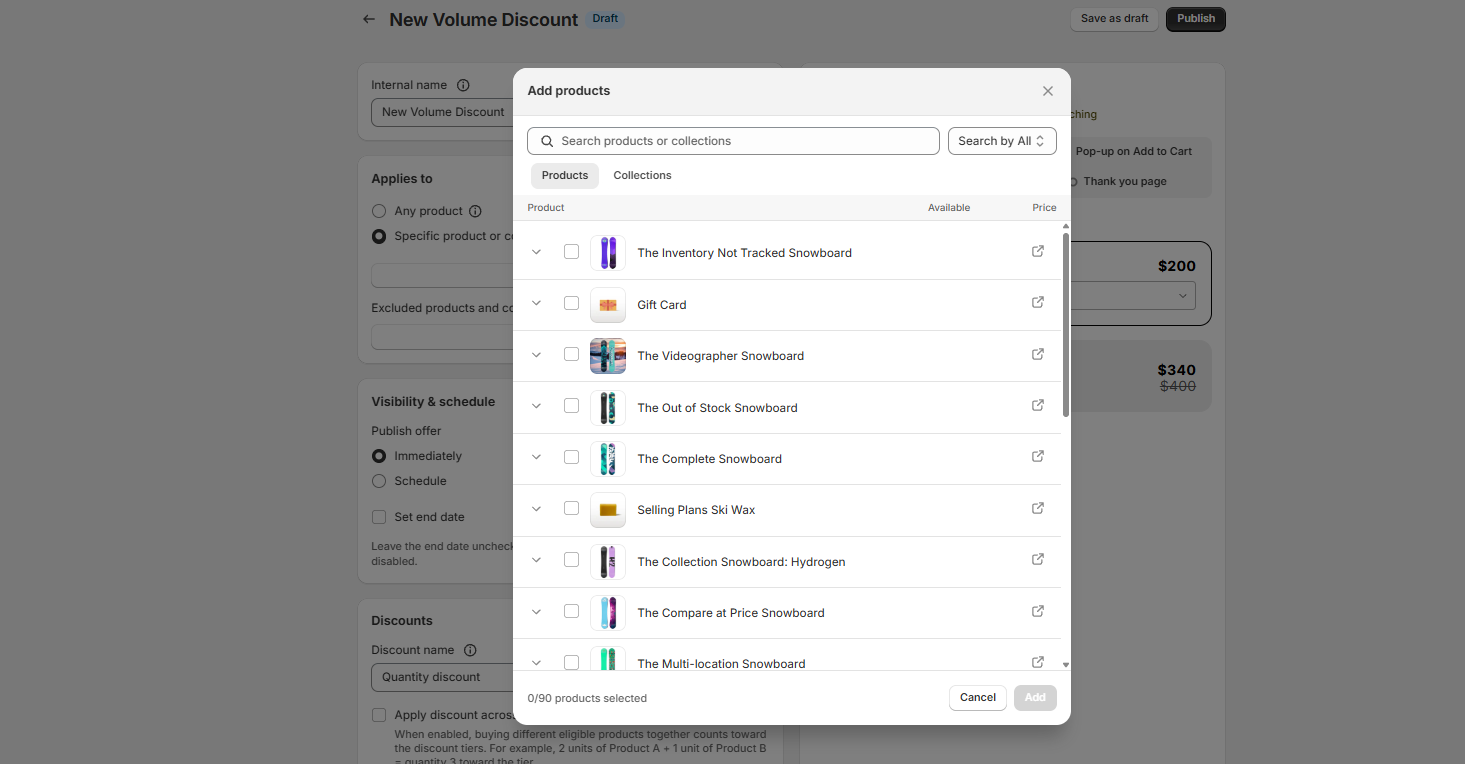
An offer can hold up to 90 products, 90 variants and 90 collections — each list has its own limit, and a product narrowed down to certain variants counts toward both the product and the variant limit. The product picker shows how many you've used (for example, 12/90 products selected). If you need more, group the products into a Shopify collection and select the collection instead.
Step 7: Select variants and a default variant (optional)
If you open a product, you can expand it to see its variants and select only the ones you want — for example, just Large and XL sizes. To include every variant, simply check the product itself.
You can also set a default variant so a specific option appears first to customers.
Step 8: Set the schedule and who sees the offer
In the Schedule card, under Publish offer, decide when the offer goes live:
- Immediately so it's active right away, or
- Schedule it for a future date and time (using your store's time zone, unless you pick a different one in Timezone).
You can also tick Set end date to set an end date if the promotion should stop on its own. With no end date, the offer stays active until you turn it off. An end date is also what a countdown timer counts down to, so you'll need one before you can add a timer in Step 15.
At the bottom of the same card, under Exclude from this offer, you can also choose who won't see the offer:
- Shopify B2B customers — hides the offer from customers who are logged in and buying for a company through Shopify B2B, so your tiered pricing stays for direct-to-consumer shoppers.
- Customers with specific tags — click Add tags and pick or type the customer tags to exclude. Anyone with one of those tags won't see the offer. Tags must match the whole tag, and capital letters don't matter.
Excluded customers don't get the discount at checkout either. Both settings are off by default, and customers are only recognized once they're logged in to their account — someone browsing without logging in still sees the offer.
Step 9: Define the discount rules and label
Set the discount label customers will see, such as Quantity Discount or Men's Discount . Then decide how the discount behaves across your eligible items:
- Apply discount across different products — turn this on if customers can mix and match items from the eligible set to reach a tier.
- Require the same variant for the discount — turn this on if the discount should only apply when the variants match exactly.
Finally, choose what the discount is calculated from. Calculate discount from sets the starting price each tier measures its savings against, and it's the one setting that decides whether your tiers show a crossed-out price:
- Price – savings are measured from the product's current selling price, and tiers show the regular price only.
- Compare-at price – savings are measured from the product's compare-at price, and that compare-at price appears crossed out on every tier, whatever discount type the tier uses. When you pick it, the note If one of the products doesn't have a compare-at price, the discount will be calculated based on the price. appears underneath.
This only changes what shoppers see — the discount they're charged is always taken off the current price. New offers start on Compare-at price; offers created before this setting existed behave as Price until you change them. A crossed-out price only appears on products whose compare-at price in Shopify is higher than their current price.
Step 10: Create quantity tiers and discount amounts
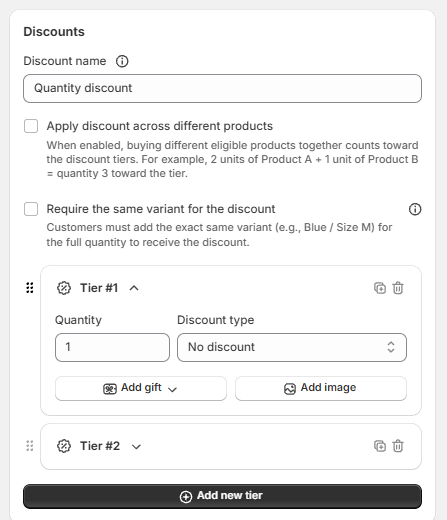
This is the heart of the offer. Define a tier for each quantity level — a default setup usually starts with at least two. For each tier, choose the discount type:
- No discount
- Percentage off
- Amount off
- Fixed price
For example: quantity 1 = no discount, quantity 4 = 20% off. Click Add new tier to create additional levels. Tier quantities are whole numbers from 1 to 999 — if you type a decimal, it's rounded down.
Step 11: Add gifts or images to tiers (optional)
Each tier can optionally include a gift, a paid add-on product, and an image of its own — all of them make the offer more eye-catching and can help conversion. You'll find Add gift, Add image and Add-on product under each tier's quantity and discount.
- A tier image. Click Add image on the tier to upload your own picture or generate one with AI. Once it's added, you can adjust its size and corner rounding, and the button becomes Edit image.
- A gift. Click Add gift and choose Single gift (one product, which the shopper gets with the tier) or Multiple gifts (the shopper picks from several products, up to a Max quantity you set).
- Gift options. Gifts are always 100% off. A single gift has a Gift quantity field, and every gift has three checkboxes: Show compare-at price shows the gift's regular price crossed out next to it, Add gift value to the bar compare-at price adds the gift's value to the tier's crossed-out total, and Visible only when bar is selected shows the gift only while its tier is the selected one.
- A picture for a single gift. A single gift shows the product's own image by default. To show something else — a lifestyle shot, a bundle photo, a "FREE" graphic — click Add gift image and pick any image from your store's Shopify Files library (in your Shopify admin, under Content → Files). The button becomes Edit gift image once one is set, Remove puts the product image back, and the Gift image size slider sets how big it appears. If you swap the gift for a different product, the picture is cleared so you never advertise the old gift. If you later delete the file from Shopify Files, the gift falls back to the product image. A Multiple gifts group always shows each product's own image.
- An add-on product. Click Add-on product and pick a product shoppers can buy together with the tier. Set its Quantity and a Discount type and value, just like a tier. Tick Selected by default to pre-check the add-on for shoppers (they can still untick it), use Visible only when bar is selected to show it only while its tier is selected, and drag Add-on image size to size its picture.
Step 12: Configure placement and appearance on the product page
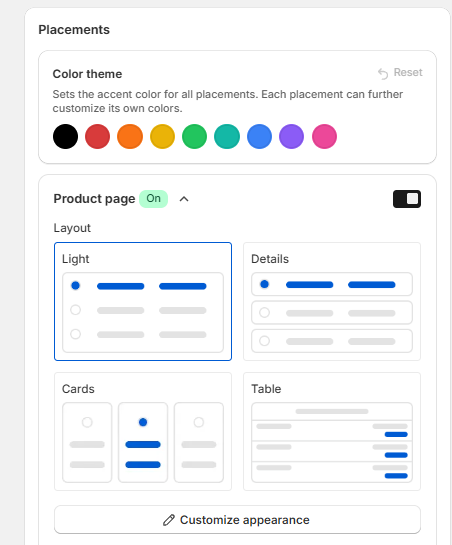
Style the offer to match your store:
- Pick a color theme (you can still fine-tune colors manually afterward).
- Switch between layout styles — Light, Details, Cards, or Table.
- Open Customize appearance to edit the look in more detail.
- Choose where the offer appears on the product page, such as above the add-to-cart button, below the product description, or above the cart section.
Step 13: Set the variant selector and display options
Decide how customers choose variants:
- Single selector for all products
- For each product
- No variant selector
You can also hide elements that might clutter or clash with your theme, including the total price, the total price without discounts, and conflicting theme selectors. These keep the offer clean and theme-compatible.
Step 14: Edit the offer text and labels
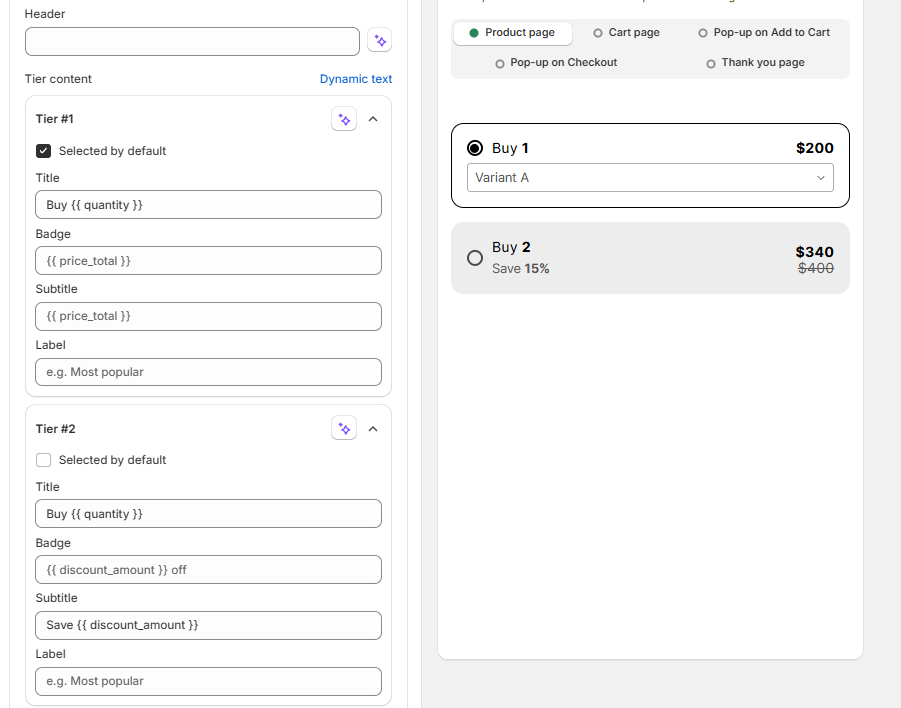
Customize the copy shoppers read. Alongside the offer's header text, each tier has its own Tier content fields: Title, Badge, Subtitle and Label (the Label field isn't shown with the Table layout). Tier sections are collapsible, so you can work through them one at a time. Use the Dynamic text link to insert product-specific details, like the quantity or price, into your copy.
Each tier also has a Selected by default checkbox, which pre-selects that tier for shoppers when the page loads. Only one tier can have it — ticking it on one tier clears the others — and it isn't shown with the Table layout, which displays every tier at once.
Step 15: Add a countdown timer (optional)
If your offer has an end date, you can show a live countdown inside the widget so shoppers can see how long the deal has left.
In the product page settings, tick Add countdown timer. If the checkbox is greyed out, the offer doesn't have an end date yet, and you'll see To display a countdown timer, set an end date in the Schedule section underneath it. Go back to Step 8, set an end date, then come back.
Once it's on, write the bar's Title. Use Insert timer to drop the live countdown into your wording (for example, "Your discount expires in: 12:34"), or let AI suggest a title with the button next to the field.
The countdown always runs to the offer's end date and disappears once the offer ends, so there's nothing else to set. To style the bar, open Customize appearance and find the Countdown timer section, with Alignment, Size, and Background and Text colors. For more detail, see Adding a Countdown Timer to Your Upsell Offers.
Step 16: Enable upsell placements across the buying journey
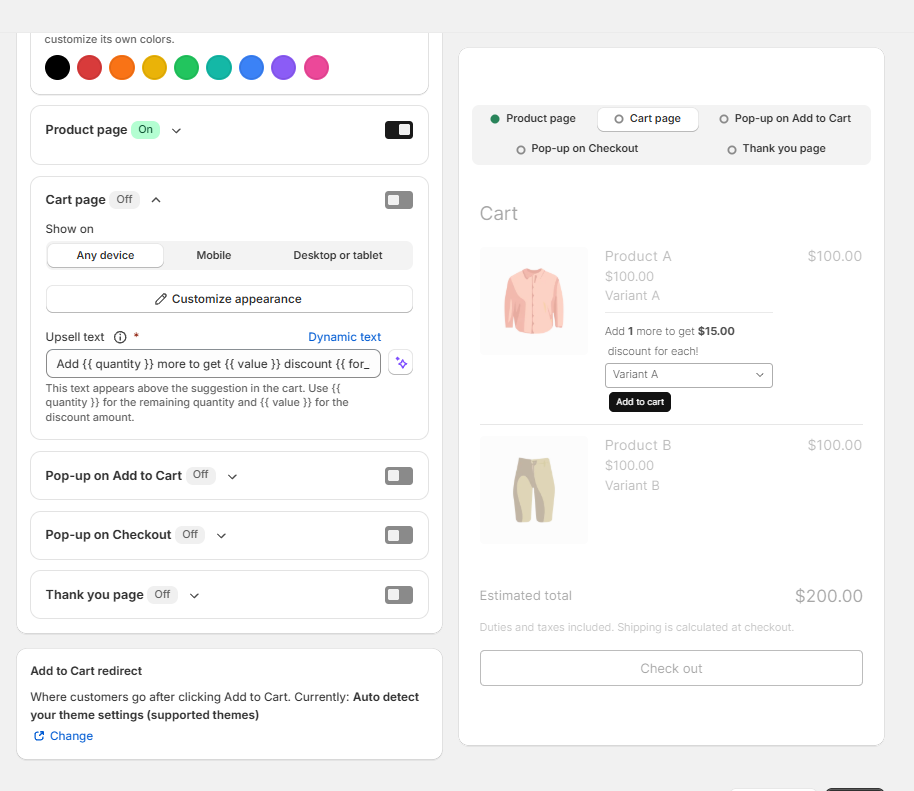
A Volume Discount doesn't have to live only on the product page. You can also surface it at:
- Cart page — an upsell suggestion in the cart
- Add to Cart pop-up — appears when an item is added
- Checkout pop-up — a prompt during checkout
- Thank You page widget — a post-purchase placement
Each placement has its own text and appearance settings, so you can tune the message for each stage of the order flow.
Step 17: Use the Thank You page as a final upsell
The Thank You page option adds a last-chance upsell after checkout. If the customer accepts, they're taken to a new checkout with the discount already applied. This is an advanced setup and may require adding the widget in the Shopify theme editor first. Done right, it closes the loop from browsing all the way to post-purchase.
Step 18: Publish the offer
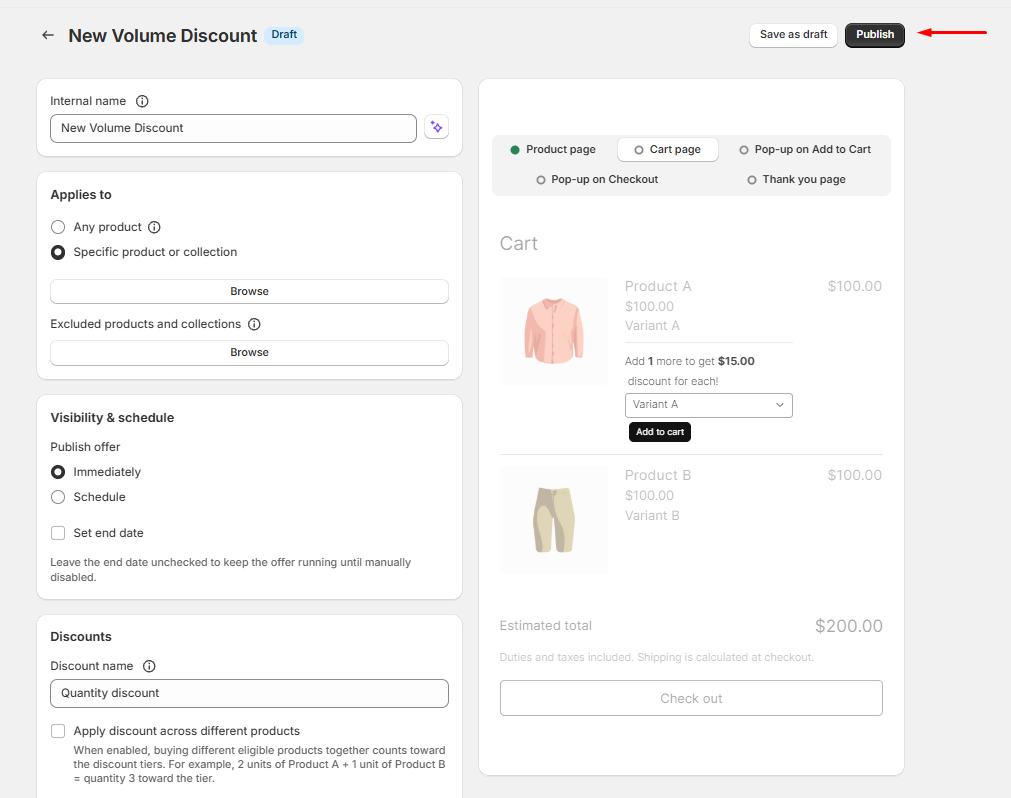
When everything's set, click Publish. The offer goes live on the product pages you selected, and any cart, checkout, or thank-you-page placements you enabled activate too. From there, the volume discount runs automatically based on the rules you configured.
Once the offer has been saved, Duplicate, Translate, Suggest feature and Analytics are in the More actions menu at the top of the offer page. Duplicate is greyed out while you have unsaved changes, and Translate only appears when your store sells in more than one language.
Tips
- Start simple with two or three tiers. A clear jump (for example, no discount at 1, then 20% off at 4) is easier for shoppers to act on than many small steps.
- Use the live preview as you build — it's the quickest way to catch a layout or color that clashes with your theme before you publish.
- Turn on Apply discount across different products when you want shoppers to mix items from a collection to reach a tier; leave it off if the deal should apply to a single product only.
- Add extra placements (cart, pop-ups, Thank You page) gradually so you can see which stage actually drives the added units.
Translating the app
If your store's language is not English, or your store is enabled to appear in multiple languages, our Vitals apps like the Volume Discounts have a Localization feature as well. For more information, you can refer to this article: Vitals translations on the storefront
Frequently Asked Questions (FAQs)
FAQ
Does the discount apply to my whole store by default?
Yes. Unless you limit it to specific products or specific collections in Step 6, the volume discount applies to all products.
What's the difference between "apply across different products" and "require the same variant"?
Apply discount across different products lets shoppers mix and match eligible items to hit a tier. Require the same variant does the opposite — the discount only applies when the variants match exactly.
Which discount types can each tier use?
Each tier can be set to no discount, percentage off, amount off, or fixed price — so you can mix, for example, a free first unit with a percentage off at higher quantities.
My tiers don't show a crossed-out price. How do I turn it on?
Open the offer and, in the Discounts card, set Calculate discount from to Compare-at price, then save. Crossed-out prices on tiers come only from this setting, so an offer created before it existed shows regular prices until you switch it. Once it's on, every tier shows the crossed-out compare-at price, as long as the product has a compare-at price in Shopify that's higher than its current price. Your shoppers are still charged the same discount; only the price comparison changes.
Can I show my own image for a tier's free gift?
Yes, on a Single gift. Click Add gift image under the gift and pick any image from your Shopify Files library (Content → Files in your Shopify admin). It replaces the gift's product photo in the offer, and the Gift image size slider controls how big it appears. If the button is greyed out, you've opened Vitals outside your Shopify admin — open it from Apps in your Shopify admin and the picker will work. A Multiple gifts group always shows each product's own image.
Do I need a separate app to show this offer in the cart or after checkout?
No. The cart, Add to Cart pop-up, Checkout pop-up, and Thank You page placements are all built into Upsell Builder. Note that the Thank You page placement may require adding its widget in the Shopify theme editor first.
Can I schedule a volume discount to run only during a promotion?
Yes. In Step 8 you can schedule a future start date and time and set an end date so the offer turns off automatically. Without an end date, it stays active until you disable it. An end date also lets you add a countdown timer to the offer, which counts down to that exact moment and disappears with it.
Can I stop wholesale or B2B customers from getting the volume discount?
Yes. In Step 8, under Exclude from this offer, tick Shopify B2B customers. If your wholesale customers come from another wholesale app rather than Shopify B2B, add the customer tag that app gives them under Customers with specific tags. Excluded customers won't see the offer or get its discount at checkout.
Can I change the layout after I've started building?
Yes. The layout you pick at the start isn't final — inside the builder you can switch between Light, Details, Cards and Table at any time.
Other FAQs